
How AI Personas Are Reshaping the Fanvue Economy in 2026
Fanvue raised $22M and crossed $100M ARR by betting on AI creators. Here's how solo creators and agencies are building scalable AI persona businesses on Fanvue — what's working, what's failing, and how to position yourself before the gold rush ends.
Denys
CEO, Fanvy.ai
On January 19, 2026, Fanvue announced a $22M Series A round and crossed $100M in annualized revenue. Buried in the press release was the line that should have rattled every serious creator and agency operator: 93% of creators on the platform use at least one AI tool.
That's not a feature adoption statistic. That's a market signal.
Fanvue isn't just allowing AI creators — it's actively building infrastructure for them: AI Voice Notes, AI Messages, AI Analytics, all native to the platform. The company has 250,000 creators, 17 million monthly active users, and is positioning itself as the default home for what it calls the "Creator AI Economy."
If you're running a Fanvue business in 2026 and you're not thinking about how AI personas fit into your strategy, you're already behind. This is the playbook for catching up before the window closes.
What an "AI persona" actually is in 2026
The phrase gets thrown around loosely, so let's get specific. There are three distinct things people mean when they say "AI on Fanvue," and they have wildly different operational implications.
Tier 1 — AI-assisted real creator. A real human creator who uses AI to handle messaging, draft replies, generate captions, or process analytics. The creator is real. The content is real. AI is operational scaffolding only. This is what 93% of Fanvue creators are doing.
Tier 2 — AI-augmented persona. A real person photographs or films real content, but the public-facing identity is fictional or anonymized. The "creator" might be presented as a different age, location, name, or backstory than the real person behind the camera. AI handles all the chat. This is the model most agencies actually run, even when they don't admit it publicly.
Tier 3 — Fully synthetic creator. Both the visuals and the personality are AI-generated. The "creator" doesn't exist as a physical person. Image models produce the photos and videos, language models handle every conversation. Fanvue requires explicit disclosure here under their AI policy, and the platform is one of the few that allows this category at all.
Each tier has its own economics, legal considerations, and scalability profile. The biggest mistake new operators make is assuming all three are interchangeable. They're not.
Why Fanvue (and not OnlyFans) for AI persona work
OnlyFans bans fully synthetic AI personas. Their AI policy was tightened throughout 2025, and by 2026 enforcement uses automated detection that flags synthetic content even when heavily processed. Agencies running AI accounts on OnlyFans are operating in policy gray areas that have already cost some operators their entire creator rosters overnight.
Fanvue made the opposite strategic choice. There's an explicit "AI Creator" checkbox at signup. The platform has dedicated moderation guidelines for synthetic content, native AI tools that assume you'll use them, and a stated commitment to "supporting creators who wish to utilise AI-generated media."
For an agency, this is the difference between operating cleanly inside platform rules versus constantly hiding what you're actually doing. The latter is a time bomb. The former is a business.
This is also why Fanvue's $100M run rate matters strategically. They're not chasing OnlyFans. They're building a different category — and they're winning the AI creator segment by default because there's no real competition for it on major platforms.
The four-layer infrastructure of an AI persona business
Running one AI account is a hobby. Running ten is a business. The difference is infrastructure.
Successful AI persona operators in 2026 are building on four distinct layers, each of which has to work independently or the whole stack collapses.
Layer 1 — Content production. This is where most beginners stop. Image generation models (Midjourney, Stable Diffusion, custom-trained LoRAs), video generation pipelines, voice cloning. The output has to be consistent across thousands of pieces of content — same face, same body, same lighting style — or the persona breaks. Operators serious about scale invest in custom-trained models per persona, not just prompts.
Layer 2 — Identity and brand. A persona needs more than visuals. She needs a consistent personality, a backstory, a writing voice, content boundaries, opinions, and a long-term arc. This gets documented in what operators call a persona bible — a living document that anyone (or any AI) on the team can reference to ensure every conversation, post, and reply stays in character.
Layer 3 — Engagement and monetization. This is the chat layer. Direct messages, mass messages, PPV (pay-per-view) campaigns, tip prompts, custom content requests. Native Fanvue AI handles the basic stuff. Serious operations use a CRM layer on top — purpose-built tools that track per-subscriber spend history, conversation context, and revenue attribution. This is where solo creators max out around 200-300 subscribers and agencies pull ahead.
Layer 4 — Operations and analytics. Multi-account management, team access controls, financial tracking, performance comparison across personas. Most operators ignore this layer until they have 5+ personas and suddenly can't tell which ones are profitable. Build it before you need it.
The agencies winning at this in 2026 didn't get there by being more creative. They got there by treating each layer as a separate engineering problem and solving them one at a time.
Realistic earnings expectations
This is the section most blog posts skip because the numbers are unflattering. Let's not skip it.
A solo operator with one AI persona, putting in 15-20 hours per week, can realistically reach $500–2,000/month within 90 days of launching. This assumes consistent content output, basic AI chat assistance, active social media promotion (TikTok, Instagram, Reddit), and decent persona positioning.
The $5,000–10,000/month tier requires either a second persona or significantly improved chat conversion. Most operators hit this around month 6-9, and the ones who don't usually quit somewhere between month 3 and 5.
The $30,000–100,000/month tier is where you find agency operators running 5-15 personas with dedicated chatter teams (or more often, AI doing 80% of chat with humans handling VIP whales). These operations are real businesses with real overhead — typically $5,000–15,000/month in tooling, content production, and team costs.
The "I made $50K my first month with one AI girl" stories on Twitter are almost universally either lies or selective screenshots from a single anomalous day. The honest answer is that AI personas on Fanvue are a real income channel, but the curve looks much more like a SaaS startup than a get-rich-quick scheme.
Where solo operators max out and agencies take over
The transition point from solo to agency-style operation usually happens around 3 personas or 300 active subscribers across all accounts, whichever comes first.
Below that line, a single operator with good AI tooling can handle everything. Above that line, the math changes:
- Conversation volume exceeds what any one person can review even at 30 seconds per message
- Content production demands shift from one creator persona to coordination across multiple
- Subscriber memory becomes impossible without dedicated CRM (you start sending the same PPV twice, forgetting whale spending tiers, missing custom requests)
- Per-persona analytics become essential or you're just guessing which personas are profitable
This is where agencies win. They've already built the operational infrastructure, the chatter SOPs, the AI prompt libraries, the per-persona persona bibles. Adding the fourth or fifth account doesn't require rebuilding any of that — it just slots into the existing system.
For solo operators reading this: the question isn't whether to scale up to agency-style operation. It's whether to do it yourself or sell your existing successful persona to an agency that already has the infrastructure.
The disclosure problem (and why it actually helps you)
Fanvue requires AI disclosure. Many creators see this as a downside. They shouldn't.
Disclosed AI personas are legally cleaner than the agencies operating in gray zones on other platforms. There's no risk of mass account termination when policy enforcement tightens. There's no risk of fan lawsuits over deception. There's no risk of payment processor freezes when compliance reviews flag your operation.
More importantly, disclosed AI personas convert better than you'd think. The 2025-2026 generation of subscribers grew up with virtual influencers. Many of them actively prefer AI personas because the parasocial relationship is cleaner — there's no awkward "is she real, do I have a chance" dynamic. The fan knows what they're paying for. The transaction is honest. The retention numbers reflect this.
The agencies trying hardest to hide AI use on Fanvue are usually the ones with the worst long-term results. The ones leaning into disclosure as a feature — clear AI badges, transparent personas, well-developed virtual brand — are building the durable businesses.
What's working in late 2026
A few specific tactics are pulling away from the pack right now.
Niche over generalist. AI personas built around specific niches (fitness, gaming, anime aesthetic, alt/goth, fitness, MILF specifically, etc.) are outperforming generalist personas at roughly 3:1 conversion. The platform discovery surface rewards specific positioning.
Voice notes as a differentiator. Fanvue's native AI Voice Notes feature has been live for most of 2026 and adoption among AI personas is still surprisingly low. Operators using voice notes report meaningfully better fan engagement and PPV conversion versus text-only.
Cross-promotion between personas. Agencies running multiple personas in adjacent niches are using subscriber-acquisition crossovers (one persona "shouts out" or "interacts with" another) to lower CAC dramatically. The technical implementation is basic but the results are non-obvious.
Long-form character development. Personas with 6+ months of consistent backstory and evolving content arcs retain subscribers 2-3x longer than personas that feel static. Agencies are starting to write actual storylines for their AI characters across multiple months.
What's failing
Equal time for the failures.
Pure prompt-and-pray content production. Operators running off-the-shelf Stable Diffusion or Midjourney without persona-specific fine-tuning produce inconsistent visuals that fans notice. The persona reads as different person across different posts. Subscriber confusion drives churn.
Generic AI chat with no persona memory. Native ChatGPT-style replies that don't remember subscriber history, spend tier, or previous conversations feel cheap. Fans pay subscriptions to feel known. AI without memory feels like a phone tree.
Spreadsheet-based operations beyond 3 accounts. This is the consistent breaking point. Operations that try to manage 4+ AI personas in Google Sheets uniformly underperform agencies running purpose-built CRM tooling. The data load just exceeds what spreadsheets can handle, and operators end up making decisions on stale or incomplete information.
How to position yourself before the window closes
Fanvue's AI-friendly positioning is a strategic moat, but it's not permanent. Two trends will eventually compress this opportunity.
First, other platforms will adapt. OnlyFans, Fansly, and others are watching Fanvue's growth. Within 18-24 months, expect at least one major competitor to relax their AI policies. When that happens, the "Fanvue is the only home for AI creators" advantage erodes.
Second, discovery on Fanvue will get more competitive. With 250,000 creators and growing fast, the platform's discovery surface gets denser every month. The personas built in 2024 and early 2025 with the now-mature followings have a structural advantage that's only growing. New entrants in 2027 will face a much harder cold start.
The window for getting in early on Fanvue's AI economy isn't closed yet, but it's closing. The operators who build serious infrastructure now — content pipelines, persona bibles, CRM layers, analytics — will be the ones with durable businesses by 2027. The ones treating it as a side project will look back in 18 months and wonder why they didn't move faster.
Conclusion
The Series A announcement was the inflection point. $22M of investor money is now flowing into Fanvue specifically to accelerate AI creator tooling. 93% of creators on the platform are already using AI tools. The next two years are going to be the formative period for the entire AI persona economy on subscription platforms.
If you're running a Fanvue business in 2026, the question isn't whether to integrate AI deeply into your operation — it's how fast you can build the infrastructure to do it well. The operators who treat this like a real business, with real systems, are going to compound. The ones who treat it like a side hustle are going to get out-scaled.
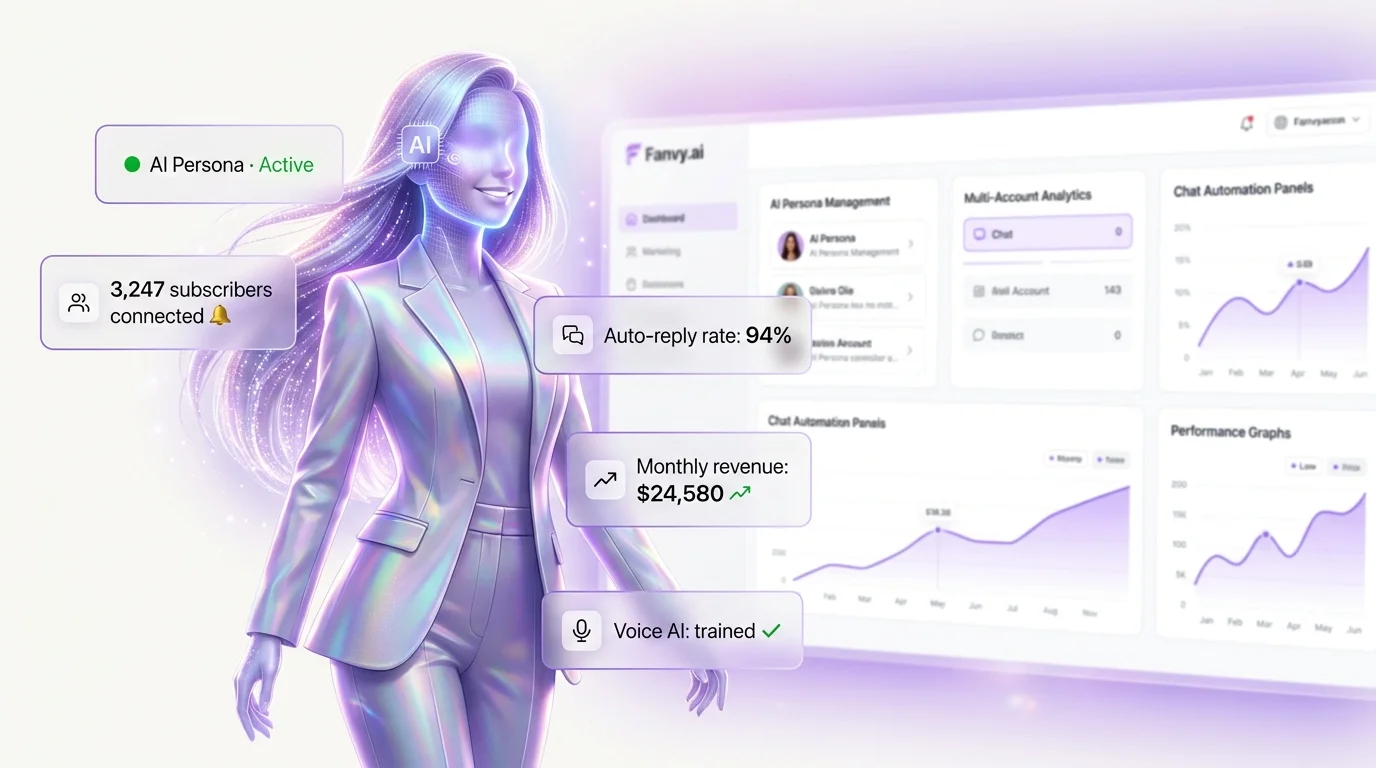
If you want a CRM purpose-built for managing multiple Fanvue accounts and AI personas — unified inbox, per-creator AI configuration, role-based team access, real-time analytics — Fanvy gives you a 7-day free trial with everything covered above. No credit card to start.
Whatever stack you build, build it now. The window is open, but it won't be open forever.
Ready to scale your Fanvue business?
Try Fanvy free for 7 days — unified inbox, AI replies, team management, and analytics for every Fanvue account.
Get started free